


DOT Blitz Week May 12–14, 2026: CVSA International Roadcheck

PTP Transport is kicking off Commercial Vehicle Safety Alliance’s (CVSA) Blitz Week with reminders to all commercial drivers. International Roadcheck is the largest targeted enforcement program for commercial motor vehicles in the world, with nearly 15 trucks and motorcoaches inspected, on average, every minute across North America for 72 hours, according to the CVSA website.
Tuesday, May 12 through Thursday, May 14, law enforcement officials will be conducting inspections on the road. This year’s Blitz Week will emphasize cargo securement and electronic logging device (ELD) tampering, falsification or manipulation. Specifically, officials will be looking for falsified or tampered records in driving logs and improperly secured loads.
Hours of Service and ELD Compliance
Hours-of-service (HOS) are in place to limit driving hours and mandate rest breaks for truck drivers. The goal is to account for and protect drivers’ rest time and ensure they aren’t fatigued on the road. Fatigue is linked to impairments comparable to being under the influence of alcohol.
Failing to maintain the log accurately or to falsify it can result in an out-of-service (OOS) violation. Carriers can be liable to prosecution and drivers will be placed on OOS until the issue is corrected.
For the 2026 International Roadcheck, inspectors will review each driver’s record of duty status and check for false or manipulated entries, with an eye on ELD tampering. According to CVSA, inaccurate ELD entries sometimes result from a driver’s misunderstanding of federal regulations and exemptions, but in other cases, records are intentionally manipulated to conceal driving time with no indication the record was edited, as required by federal regulations. In 2025, falsification of record of duty status was the second most-cited driver violation, with 58,382 violations recorded.
According to the International Roadcheck 2026 flyer, inspectors will look for:
- Electronic logging device (ELD) tampering, including driving while not logged in, disconnected devices and improper edits
- Ghost drivers (claiming a co-driver when no co-driver is present)
- Improper use of the personal conveyance special driving category
- Improper use of other exceptions, including adverse driving conditions
- Recording off-duty time while performing work for a motor carrier or a non-motor carrier
Cargo Securement
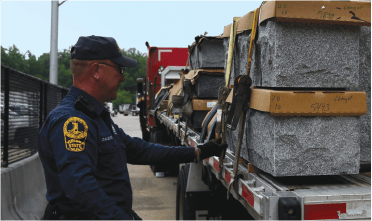
Proper cargo securement is a critical factor in overall road safety. Improperly or inadequately secured cargo poses a serious risk to both the driver and the public by adversely affecting the vehicle’s maneuverability and potentially causing loads to fall or become dislodged, creating roadway hazards and increasing the risk of crashes. In 2025 alone, over 18,000 violations were issued for cargo not secured to prevent leaking, spilling, blowing or falling, and more than 16,000 violations involved vehicle components or dunnage not being secured. Proactive attention to cargo securement is far less expensive and time-consuming than dealing with an OOS violation on the road.
During the vehicle portion of a Level I inspection, officers may check:
- That cargo is contained, immobilized and secured so it cannot shift, tip, fall or leak
- That the aggregate working load limit of all tiedowns is at least half the weight of the
cargo being secured - The condition and proper use of tiedowns, dunnage, shoring bars and other securement systems
- That vehicle components and dunnage are also properly secured
- Any load that appears capable of shifting, leaking or falling may result in the vehicle being
placed out of service immediately
Prepping for the Inspection Process
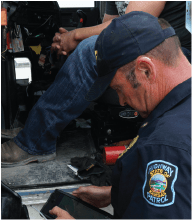
During Roadcheck inspections, officers typically conduct the North American Standard Level I Inspection, a 37-step procedure that evaluates both driver operating requirements and vehicle mechanical condition. This may include checking safety equipment like fire extinguishers or safety triangles.
If a driver is stopped during a Roadcheck inspection, remain respectful and cooperative and make sure all required documents are easily accessible, including:
- Commercial driver’s license (CDL)
- Medical Examiner’s Certificate
- Vehicle registration
- Proof of insurance
- Record of duty status
- ELD
It’s important to remember Blitz Week is all about safety. If you are on the road this week, plan for stops, be patient as you may have to wait in line for an inspection and remember, everything you check during a pre-trip inspection is what officers are checking during a Level I inspection. Be Safe on the Road!
Download the Inspection Cheat Sheet
At PTP Transport, we’re committed to helping our drivers succeed on the road and beyond. Visit our website to learn more about driving for PTP or browse our open positions.